Location of a settlement relative to surrounding features and other places?
Answer: Situation
Movement of people out of large cities to smaller towns and the countryside?
Answer: Counter-urbanisation
Decline of manufacturing employment in a city or region?
Answer: Deindustrialisation
IB Geography · Option · SL and HL
IB Geography Option G: Urban environments
2 ready-made review sets for this option, 28 questions in all, for SL and HL, to play as a class game on the projector. Free to host, and students join with a code.
A question from the sets
Location of a settlement relative to surrounding features and other places?
- Site
- Morphology
- Hinterland
- SituationRight answer
What Option G covers
Option G starts with the variety of urban environments: site and situation, primate cities, and the models of land use within a city, from bid-rent theory to Burgess's concentric zones and Hoyt's sectors, with informal settlements and the informal sector. Changing urban systems: suburbanisation, counter-urbanisation and reurbanisation, gentrification, deindustrialisation, urban sprawl and the reuse of brownfield sites. Urban environmental and social stresses: the urban heat island, photochemical smog and temperature inversions, congestion, segregation and gated communities. Building sustainable urban systems for the future: congestion charges, park and ride and bus rapid transit, green belts and compact cities, and eco-cities, smart cities and resilient cities.
Where students slip
- A settlement's site is the land it is built on, such as a river terrace or a defensible hill. Its situation is where it sits in relation to the places and features around it, such as a crossing point or a coast.
- Suburbanisation is moving out to the edge of the city, which still grows the urban area. Counter-urbanisation is leaving the city altogether, for smaller towns and the countryside beyond.
- A primate city is defined by its size relative to the next largest city in its country, more than twice as big, not by being the capital or a megacity.
The sets
Play this set opens the set in splycr, where you can read every question and host it for your class straight away. Hosting needs no account, and students join with the code on the board. A free account lets you copy a set and edit it.
The questions were written for the splycr library by Biology by Bradford. Each one plays as multiple choice, and the three wrong options were written for that question.
Brown haze formed when sunlight acts on vehicle exhaust gases?
Answer: Photochemical smog
Concentration of ethnic or social groups in separate neighbourhoods?
Answer: Segregation
Dense, mixed-use development that reduces car dependence and sprawl?
Answer: Compact city
Game modes that suit this unit or option
Every set plays in all eight modes. These two fit this unit or option best.
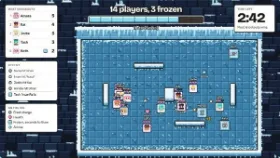
Cryo
For a quick review between urban case studies: students move round a frozen arena and answer a question from the set correctly to reload. Up to 20 players.

Sabotage
Suburbanisation, counter-urbanisation, reurbanisation and gentrification are four movements that are easy to swap. Sabotage runs to a clock you set (3, 5 or 8 minutes), not through the deck, so the questions keep coming until time is up, and power cards (freeze, steal, swap, shield) keep a student who is behind in the game.