Organelle where proteins are synthesised from amino acids?
Answer: Ribosome
Small extra rings of DNA found in many bacteria?
Answer: Plasmids
Biconcave cell with no nucleus that carries oxygen around the body?
Answer: Red blood cell
General Biology · Grade 10
General Biology review games
Ready-made review sets for Grade 10 biology: 19 sets and 356 questions, one topic each, to play as a class game on the projector. Free to host, and students join with a code.
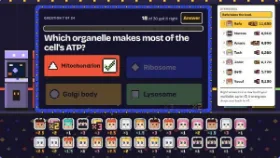
A question from the sets
Molecule that an enzyme acts on?
- SubstrateRight answer
- Product
- Inhibitor
- Catalyst
The 19 sets
Play this set opens the set in splycr, where you can read every question and host it for your class straight away. Hosting needs no account, and students join with the code on the board. A free account lets you copy a set and edit it.
The questions were written for the splycr library by Biology by Bradford. Each one plays as multiple choice, and the three wrong options were written for that question.
Ability to distinguish two points that are close together as separate?
Answer: Resolution
Real length of a cell that measures 20 mm in a drawing at ×1000?
Answer: 20 µm
Control used first, at low power, to bring a specimen roughly into view?
Answer: Coarse focus
Net movement of water through a partially permeable membrane from a dilute to a more concentrated solution?
Answer: Osmosis
State of a plant cell whose membrane has pulled away from the wall in a concentrated solution?
Answer: Plasmolysed
As an organism gets larger, its surface area to volume ratio…?
Answer: Falls
Division that produces four genetically different haploid gametes?
Answer: Meiosis
Type of tumour that stays in one place and does not invade other tissues?
Answer: Benign
Regions at shoot and root tips where plant cells divide by mitosis?
Answer: Meristems
Elements found in all nucleic acids?
Answer: C, H, O, N and P
Reaction that uses water to break the bond between two monomers?
Answer: Hydrolysis
Group of biological molecules that forms enzymes and is used to repair tissues?
Answer: Proteins
Five-carbon sugar found in RNA nucleotides?
Answer: Ribose
Unbranched component of starch that coils into a helix?
Answer: Amylose
Colour of iodine solution in the presence of starch?
Answer: Blue-black
A triglyceride forms by condensation between one glycerol and…?
Answer: Three fatty acids
Term for a molecule, such as a phospholipid, with both a water-loving and a water-repelling part?
Answer: Amphipathic
Fat-storing tissue under the skin that insulates the body?
Answer: Adipose tissue
Bond formed between two amino acids by condensation?
Answer: Peptide bond
Protein hormone that lowers blood glucose concentration?
Answer: Insulin
Number of strands in an mRNA molecule?
Answer: One
Which statement best defines metabolism?
Answer: All enzyme-catalysed reactions in a cell or organism
Which element is found in proteins and nucleic acids but not in carbohydrates?
Answer: Nitrogen
What term describes a fatty acid with no C=C double bonds in its chain?
Answer: Saturated
Molecule that an enzyme acts on?
Answer: Substrate
Optimum temperature of most human enzymes?
Answer: 37 °C
Proteases break proteins down into…?
Answer: Amino acids
Products in the balanced equation 6CO₂ + 6H₂O → …?
Answer: C₆H₁₂O₆ + 6O₂
Tissue that carries water up to the leaves?
Answer: Xylem
Mineral ion plants absorb from the soil to make amino acids?
Answer: Nitrate
Main fuel molecule broken down in cell respiration?
Answer: Glucose
Product of anaerobic respiration in human muscle?
Answer: Lactic acid
Chemical in a respirometer that absorbs carbon dioxide?
Answer: Soda lime
Base that pairs with adenine in DNA?
Answer: Thymine
Number of bases that code for one amino acid?
Answer: 3
Random change in the base sequence of DNA?
Answer: Mutation
Allele that is expressed when only one copy is present?
Answer: Dominant
Probability that a cross of Aa × aa produces an aa offspring?
Answer: 50%
Type of variation with a range of values, such as height?
Answer: Continuous
Naturalist whose 1858 letter from south-east Asia, describing the same idea, prompted Darwin to publish?
Answer: Alfred Russel Wallace
When an antibiotic is used, the bacteria that are killed first are the…?
Answer: Non-resistant ones
Islands where Darwin studied finches and giant tortoises?
Answer: Galápagos Islands
Swedish scientist who introduced two-part scientific names?
Answer: Carl Linnaeus
Kingdom of organisms with chitin cell walls that feed by extracellular digestion?
Answer: Fungi
Identification tool made of pairs of contrasting statements?
Answer: Dichotomous key
All the populations of different species living in an area?
Answer: Community
Arrows in a food chain point in the direction of…?
Answer: Energy transfer
Relationship in which one organism benefits and its host is harmed, as with a tapeworm?
Answer: Parasitism
Burning fossil fuels releases carbon dioxide by which process?
Answer: Combustion
Cooling of water vapour to form clouds?
Answer: Condensation
Gas released when drained peat bogs are burned or left to decay in air?
Answer: Carbon dioxide
Organ that absorbs much of the remaining water from undigested food?
Answer: Large intestine
Heart chamber that pumps oxygenated blood to the body?
Answer: Left ventricle
Tiny air sacs in the lungs where gas exchange takes place?
Answer: Alveoli
What the sets cover
Nineteen sets on the biology most courses teach around Grade 10, one topic each: cell structure, microscopy, transport in cells and cell division; biological molecules in four sets (metabolism, carbohydrates, lipids, and proteins and nucleic acids) and an overview set to finish them; enzymes, photosynthesis and respiration; DNA and protein synthesis, inheritance, evolution and natural selection, and classification; ecosystems and energy flow, and nutrient cycles and human impact; and the human body systems. Play the set for the topic you have just taught, or use them together as a review of the basics before IB or AP Biology.
Where students slip
- Osmosis is the movement of water, not of the dissolved substance, across a partially permeable membrane, from a dilute solution to a more concentrated one.
- An enzyme that is too hot is denatured, not killed: the shape of its active site changes, so the substrate no longer fits. Enzymes were never alive.
- Plants respire all the time, day and night. In the light, photosynthesis is faster than respiration, so the plant takes in more carbon dioxide than it gives out.
- Condensation joins two molecules and releases water; hydrolysis uses water to break the bond. Both are catalysed by enzymes.
Game modes that suit these sets
Every set plays in all eight modes. These two fit these sets best.

Racer solo
In solo Racer the track is as long as the set, up to 12 cards, and one wrong answer sends a student back to the start. Every General Biology set has 16 to 20 questions, so finishing takes twelve right answers in a row.

Boss Battle
Biology is full of pairs that look alike under pressure: diffusion and osmosis, aerobic and anaerobic respiration, condensation and hydrolysis. A wrong answer heals the boss, so a class that guesses loses ground.
Why review with a game
Answering from memory does more for recall than rereading notes, and a game gets the whole class answering, not just the students with a hand up. Every question in these sets is short, with a one-line answer, so a set makes a quick starter, a check at the end of a topic, or a review before a test.
How a class plays
- Open a set and press Host a game. Pick one of the sets above and choose a game mode. You don't need an account to host.
- Put the room code on the projector. It comes with a QR code that opens the game on a phone.
- Students join with the code and their first name. They go to splycr.com on a phone, tablet or laptop. No student accounts, nothing to install.
A free account lets you copy a set to edit it, write your own, and set it as homework.
Eight ways to play the same set
- Boss BattleThe whole class fights one boss. Right answers hit it, wrong ones heal it.
- RacerEach right answer moves you forward. Play solo or in teams.
 KaboomAnswer right to pass the bomb on. Hold it when it goes off and your points go to everyone else.
 SabotageRight answers earn coins and cards that freeze, steal, swap or shield.
 ThroneOne student holds the throne and the rest of the class tries to take it.
 SplycrQuick-fire questions. A streak stacks your multiplier up to three times.
 CryoA frozen arena of frost charges. Answer a question to reload.
 OutbreakA first-person zombie arena for laptops. Answer right to get back in.
Questions teachers ask
Do students need an account?
No. Students join with the code on the board and their first name, from any browser. There is nothing to install.
Is it free?
Hosting a game is free, with or without an account, and so is an account. Only generating new questions with the question generator uses credits; these sets are already written.
Which course do the sets follow?
No single exam board's. They cover the biology most courses teach around Grade 10, from cells to ecology and the human body, so they suit GCSE, IGCSE and MYP classes, or a review of the basics at the start of IB or AP Biology. Each set is one topic, named plainly.
What kind of questions are they?
Short questions with a one-line answer: a word, a name or a structure, such as the organelle where most aerobic respiration takes place, or the bond that joins two monosaccharides. They are for retrieval practice and vocabulary review.
Where do the questions come from?
They were written for the splycr library by Biology by Bradford. The biological molecules sets follow its own question sheets, retrieval quiz and task cards. Each question plays as multiple choice, with three wrong options written for that question.
Can I change the questions?
Yes. A free account lets you copy any set and edit it, or write a set of your own.
Teaching older classes, or chemistry too? The library has sets for these courses as well.