Ground that stays at or below 0 °C for at least two consecutive years?
Answer: Permafrost
Slow downslope flow of saturated active-layer soil over frozen ground?
Answer: Solifluction
Steep-sided, usually dry desert valley that floods after rare storms?
Answer: Wadi
IB Geography · Option · SL and HL
IB Geography Option C: Extreme environments
2 ready-made review sets for this option, 29 questions in all, for SL and HL, to play as a class game on the projector. Free to host, and students join with a code.
A question from the sets
Ground that stays at or below 0 °C for at least two consecutive years?
- Active layer
- Tundra
- PermafrostRight answer
- Talik
What Option C covers
Option C covers the characteristics of extreme environments: hot and cold drylands, polar and periglacial regions and high altitudes, and what makes them hard places to live, from aridity to permafrost and hypoxia. Physical processes and landscapes: glacial erosion, such as plucking, and landforms such as corries and drumlins; periglacial processes such as freeze–thaw weathering, frost heave and solifluction, and landforms such as pingos; and desert processes such as deflation and exfoliation, with wadis and barchan dunes. Managing extreme environments: nomadic pastoralism and transhumance, desertification and overgrazing, resource frontiers, and ways of finding water, from qanats to fog harvesting. Extreme environments' futures: thawing permafrost and thermokarst, glacial lake outburst floods, new Arctic shipping routes, the Antarctic Treaty, and renewable energy such as concentrated solar power.
Where students slip
- A desert is defined by dryness, not by heat. Antarctica gets so little precipitation that it is the largest desert on Earth, and a cold one.
- Permafrost is defined by temperature, not by ice: it is ground that stays at or below 0 °C for at least two consecutive years. The active layer above it thaws every summer, so frozen ground in winter is not necessarily permafrost.
- Desertification is not deserts advancing across their edges. It is the degradation of land in arid, semi-arid and dry sub-humid areas, through climate variation and human activity such as overgrazing, and it can happen far from any desert.
The sets
Play this set opens the set in splycr, where you can read every question and host it for your class straight away. Hosting needs no account, and students join with the code on the board. A free account lets you copy a set and edit it.
The questions were written for the splycr library by Biology by Bradford. Each one plays as multiple choice, and the three wrong options were written for that question.
Keeping more livestock than pasture can support, stripping vegetation cover?
Answer: Overgrazing
1959 agreement reserving a continent for peace and science and banning military activity?
Answer: Antarctic Treaty
Dark particles from fires and engines that settle on snow, lowering albedo and speeding melt?
Answer: Black carbon
Game modes that suit this unit or option
Every set plays in all eight modes. These two fit this unit or option best.

Kaboom
Option C answers are short landform and process names (pingo, corrie, wadi, barchan), so the bomb moves fast and every student answers many times, and everyone plays to the last explosion.
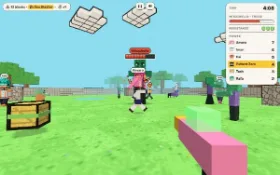
Outbreak
For a class with laptops: a 3D zombie arena where an infected student answers a question from the set correctly to get back in. Up to 40 players, with a keyboard and mouse.