Conjugate acid of NH₃?
Answer: NH₄⁺
pH of 0.010 mol dm⁻³ HCl?
Answer: 2
Equal concentrations of HCl and CH₃COOH: which has the higher pH?
Answer: Ethanoic acid
IB Chemistry · Reactivity 3
IB Chemistry Reactivity 3: What are the mechanisms of chemical change?
7 ready-made review sets for this topic, by subtopic and marked SL or HL, 104 questions in all, to play as a class game on the projector. Free to host, and students join with a code.
A question from the sets
Conjugate acid of NH₃?
- NH₂⁻
- H₃O⁺
- NH₄⁺Right answer
- NH₃⁺
What Reactivity 3 covers
Reactivity 3 is the four ways reactions happen. R3.1 is proton transfer: Brønsted–Lowry acids and bases and conjugate pairs, the pH scale and Kw, strong and weak acids and bases, and neutralisation and titration; at higher level, pOH, Ka, Kb, pKa and pKb, the pH of salt solutions, pH curves, indicators and buffers. R3.2 is electron transfer: oxidation states, half-equations, primary and secondary cells, electrolysis of molten salts, and the oxidation of alcohols; at higher level, standard electrode potentials, ΔG⦵ = −nFE⦵, the electrolysis of aqueous solutions, and electroplating. R3.3 is electron sharing: radicals, homolytic fission and the substitution of alkanes by halogens. R3.4 is electron-pair sharing: nucleophilic substitution of halogenoalkanes and electrophilic addition to alkenes, then at higher level Lewis acids and bases, Sₙ1 and Sₙ2 mechanisms, Markovnikov's rule and the nitration of benzene.
Where students slip
- Strong and weak say how far an acid dissociates; concentrated and dilute say how much of it is in the solution. A dilute strong acid can have a higher pH than a concentrated weak one.
- Oxidation happens at the anode in every cell, voltaic or electrolytic. What changes is its sign: the anode is negative in a voltaic cell and positive in electrolysis.
- HL A curly arrow shows a pair of electrons moving. It starts at a lone pair or a bond and points to where the pair ends up, not at the atom that moves.
The sets
Play this set opens the set in splycr, where you can read every question and host it for your class straight away. Hosting needs no account, and students join with the code on the board. A free account lets you copy a set and edit it.
The questions were written for the splycr library by Biology by Bradford. Each one plays as multiple choice, and the three wrong options were written for that question.
Sets marked SL suit every IB Chemistry student, because higher level students study the standard level content too. Sets marked HL cover the additional higher level material: ten subtopics have an HL set after their SL one, and R1.4 Entropy and spontaneity, which is for higher level only, has an HL set of its own.
R3.1 Proton transfer reactions
Of two weak acids, the stronger one has the…pKa?
Answer: Smaller
At the half-equivalence point of a weak acid–strong base titration, pH equals…?
Answer: pKa
Pair of substances that forms an acidic buffer?
Answer: CH₃COOH and CH₃COONa
R3.2 Electron transfer reactions
Oxidation state of manganese in KMnO₄?
Answer: +7
In a primary (voltaic) cell, electrons flow through the external circuit from…?
Answer: Anode to cathode
Product of oxidising propan-2-ol with acidified K₂Cr₂O₇?
Answer: Propanone
E⦵cell for a Zn/Zn²⁺ (−0.76 V) and Cu²⁺/Cu (+0.34 V) cell?
Answer: +1.10 V
Equation linking ΔG⦵ to E⦵?
Answer: ΔG⦵ = −nFE⦵
Product at an inert anode in the electrolysis of aqueous CuSO₄?
Answer: Oxygen
R3.3 Electron sharing reactions
Bond breaking in which each atom keeps one of the shared electrons?
Answer: Homolytic fission
Equation for the initiation step in the chlorination of methane?
Answer: Cl₂ → 2Cl•
Dichloromethane forms alongside chloromethane because of…?
Answer: Further substitution
R3.4 Electron-pair sharing reactions
Electron-pair donor that attacks an electron-deficient carbon?
Answer: Nucleophile
Type of reaction between CH₃CH₂Br and aqueous OH⁻?
Answer: Nucleophilic substitution
Product of ethene with bromine?
Answer: 1,2-dibromoethane
Type of halogenoalkane that reacts mainly by Sₙ1?
Answer: Tertiary
Effect of an Sₙ2 reaction on the configuration at a chiral carbon?
Answer: Inversion
Major product of propene with HBr?
Answer: 2-bromopropane
Game modes that suit this topic
Every set plays in all eight modes. These two fit this topic best.
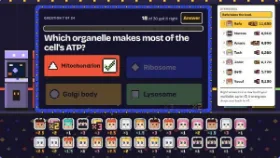
Splycr
Reactivity 3 is full of pairs that end a streak: oxidising and reducing agent, anode and cathode, nucleophile and electrophile. A streak raises the multiplier to 3× and one slip drops it back to 1×, so the student who keeps them straight pulls ahead.

Cryo
For a lighter lesson after a heavy topic: students move round a frozen arena and answer a question from the set correctly to reload. Up to 20 players.