Combination with uniform composition throughout, such as salt water?
Answer: Homogeneous mixture
Change of state from solid directly to gas?
Answer: Sublimation
25 °C expressed in kelvin?
Answer: 298 K
IB Chemistry · Structure 1
IB Chemistry Structure 1: Models of the particulate nature of matter
6 ready-made review sets for this topic, by subtopic and marked SL or HL, 86 questions in all, to play as a class game on the projector. Free to host, and students join with a code.
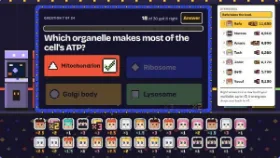
A question from the sets
Combination with uniform composition throughout, such as salt water?
- Homogeneous mixtureRight answer
- Heterogeneous mixture
- Pure substance
- Ionic compound
What Structure 1 covers
Structure 1 is the particle model the rest of the course builds on. S1.1 sorts matter into elements, compounds and mixtures, with the techniques that separate mixtures, the changes of state, and the link between temperature in kelvin and the average kinetic energy of the particles. S1.2 is the nuclear atom: subatomic particles, isotopes and relative atomic mass, with mass spectra at higher level. S1.3 covers emission spectra and electron configurations, and at higher level, ionisation energies and what successive ionisation energies reveal. S1.4 is the mole: molar mass, empirical and molecular formulas, and concentration. S1.5 is the ideal gas model, the gas laws and the ideal gas equation.
Where students slip
- Temperature in kelvin is proportional to the average kinetic energy of the particles. While a substance melts or boils its temperature stays the same: the energy goes into overcoming the forces between the particles, not into making them move faster.
- Fe²⁺ is [Ar] 3d⁶, not [Ar] 3d⁴ 4s². A transition metal atom loses its 4s electrons before its 3d electrons, even though 4s fills first.
- The IB's STP is 273 K and 100 kPa, so the molar volume of an ideal gas is 22.7 dm³ mol⁻¹, not the 22.4 dm³ mol⁻¹ of older books. In PV = nRT, pressure goes in pascals and volume in cubic metres.
The sets
Play this set opens the set in splycr, where you can read every question and host it for your class straight away. Hosting needs no account, and students join with the code on the board. A free account lets you copy a set and edit it.
The questions were written for the splycr library by Biology by Bradford. Each one plays as multiple choice, and the three wrong options were written for that question.
Sets marked SL suit every IB Chemistry student, because higher level students study the standard level content too. Sets marked HL cover the additional higher level material: ten subtopics have an HL set after their SL one, and R1.4 Entropy and spontaneity, which is for higher level only, has an HL set of its own.
S1.1 Introduction to the particulate nature of matter
S1.2 The nuclear atom
Neutrons in ³⁷Cl (Z = 17)?
Answer: 20
Species with the same number of electrons, such as Na⁺ and F⁻?
Answer: Isoelectronic
Ar of chlorine with 75% ³⁵Cl and 25% ³⁷Cl?
Answer: 35.5
S1.3 Electron configurations
Visible lines in hydrogen's spectrum come from transitions down to which level?
Answer: n = 2
Rule that an orbital holds at most two electrons, with opposite spins?
Answer: Pauli exclusion principle
Condensed electron configuration of chromium (Z = 24)?
Answer: [Ar] 3d⁵ 4s¹
Hydrogen's ionisation energy is found from the frequency at the spectrum's…?
Answer: Convergence limit
Successive IEs: 578, 1817, 2745, 11577 kJ mol⁻¹. Which group is the element in?
Answer: Group 13
First IE of S is lower than P's because the electron removed from S is…?
Answer: Spin-paired
S1.4 Counting particles by mass: The mole
Relative formula mass of H₂SO₄ (Ar: H 1, S 32, O 16)?
Answer: 98
A hydrocarbon has empirical formula CH₂ and Mr = 56. Its molecular formula?
Answer: C₄H₈
Volume of 1.0 mol dm⁻³ stock needed for 500 cm³ of 0.20 mol dm⁻³ solution?
Answer: 100 cm³
S1.5 Ideal gases
Conditions under which real gases deviate most from ideal behaviour?
Answer: High pressure, low temperature
At constant pressure, 1.0 dm³ of gas heated from 200 K to 400 K occupies…?
Answer: 2.0 dm³
Unit of volume needed in PV = nRT when pressure is in Pa?
Answer: m³
Game modes that suit this topic
Every set plays in all eight modes. These two fit this topic best.

Racer in teams
Structure 1 is full of quick calculations: the neutrons in an isotope, the moles in a mass, the volume of a gas at STP. In team Racer only one teammate sees the right option and a wrong answer sends the whole team back, so someone has to do the sum out loud before anyone taps.
Splycr
Electron configurations and the Aufbau principle, Pauli exclusion principle and Hund's rule are easy to half-know. A streak raises the multiplier to 3× and one slip drops it back to 1×, so the student who knows that chromium is [Ar] 3d⁵ 4s¹ pulls ahead.