4 ready-made review sets for this topic, 50 questions in all, marked SL or HL, to play as a class game on the projector. Free to host, and students join with a code.
Topic 2 is the biggest topic in the course. It starts with individuals, populations, communities and ecosystems: species, habitats and niches, abiotic and biotic factors, carrying capacity, population growth curves, and sampling with quadrats and the Lincoln index. Then energy and biomass (photosynthesis and respiration, trophic levels, productivity, ecological pyramids, bioaccumulation and biomagnification), the carbon cycle, climate and biomes, and zonation and succession. At higher level it adds the nitrogen cycle and methane, El Niño and La Niña, and plagioclimax communities.
2.1 Individuals, populations, communities and ecosystems
2.2 Energy and biomass in ecosystems
2.3 Biogeochemical cycles
2.4 Climate and biomes
2.5 Zonation, succession and change in ecosystems
Where students slip
Energy flows through an ecosystem and is lost as heat at each trophic level; matter, such as carbon and nitrogen, is recycled.
Gross productivity is the total gain before respiration. Net productivity is what is left after respiration, and only that is available to the next trophic level.
Bioaccumulation is a pollutant building up in one organism over its life; biomagnification is its concentration rising from one trophic level to the next.
HL Nitrogen fixation turns N₂ into ammonia, nitrification turns ammonia into nitrates, and denitrification turns nitrates back into N₂ in anaerobic soil.
Primary succession starts where there is no soil, such as bare rock or a new lava flow; secondary succession starts where soil is already there, after a fire or when farmland is abandoned.
The sets
Play this set opens the set in splycr, where you can read every question and host it for your class straight away. Hosting needs no account, and students join with the code on the board. A free account lets you copy a set and edit it.
The questions come from the Biology by Bradford flashcard bank. Each one plays as multiple choice, and the wrong options are other answers from the same set.
ESS has had a higher level course since the guide first assessed in 2026. Sets marked SL suit every ESS student, because higher level students study the standard level content too. Sets marked HL cover the additional higher level material in topics 2 to 8; Topic 1 has none, so its sets are all SL. The three HL lenses (environmental law, economics and ethics) have no sets yet.
Topic 2: Ecology (part 1)
15 questionsSL
The particular set of abiotic and biotic conditions and resources upon which an organism or population depends?
Answer: Ecological niche
The maximum population size a habitat can support given its limited resources?
Answer: Carrying capacity
A species that has a disproportionately large effect on community structure relative to its abundance?
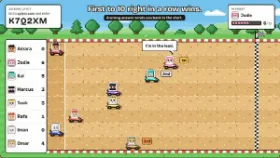
Topic 2 is full of terms that are easy to swap: gross or net productivity, bioaccumulation or biomagnification, primary or secondary succession. In team Racer only one teammate has the right option and a wrong answer sends the whole team back, so students argue it out first.
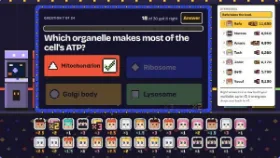
Every right answer in a row raises a student's multiplier, up to 3×, and one slip drops it back to 1×. In the biggest topic of the course, it shows quickly who knows the vocabulary cold.