Theme A is about what all living things share and how they came to be so varied. At the level of molecules it covers water and nucleic acids; at the level of cells, cell structure, with the origins of cells and viruses at higher level; at the level of organisms, the diversity of organisms, with classification and cladistics at higher level; and at the level of ecosystems, evolution and speciation, and the conservation of biodiversity.
Where students slip
Hydrogen bonds hold water molecules to one another. The bonds within a water molecule are polar covalent.
70S ribosomes are found in prokaryotes, and in mitochondria and chloroplasts; 80S ribosomes are in the cytoplasm of eukaryotic cells.
Viruses are not cells. They have no metabolism of their own and can only replicate inside a host cell.
The biological species concept doesn't work for organisms that reproduce asexually, such as bacteria.
In situ conservation protects a species where it lives; ex situ moves it to a zoo, botanic garden or seed bank.
The sets
Play this set opens the set in splycr, where you can read every question and host it for your class straight away. Hosting needs no account, and students join with the code on the board. A free account lets you copy a set and edit it.
The questions come from the Biology by Bradford flashcard bank, written by an IB and AP Biology teacher. Each one plays as multiple choice, and the wrong options are other answers from the same set.
Sets marked SL suit every IB Biology student, because higher level students study the standard level content too. Sets marked HL cover the additional higher level material, and six subtopics are for higher level only: A2.1, A2.3, A3.2, B3.3, C2.1 and D2.2. Some sets are marked SL and HL, and cover both.
A1 · Molecules
A1.1 Water
A1.1 Water
12 questionsSL
Intermolecular attraction between the partial positive H and partial negative O of neighbor molecules?
Answer: Hydrogen bond
Water molecules "sticking" to each other due to H-bonding?
Answer: Cohesion
Energy needed to raise the temperature of 1 g of water by 1 °C (helps keep temperatures stable)?
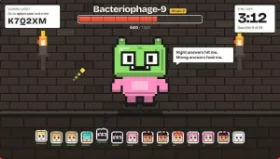
Theme A is heavy on terms that sit close together: purines and pyrimidines, lytic and lysogenic, in situ and ex situ. A wrong answer heals the boss, so the class gains nothing by guessing.
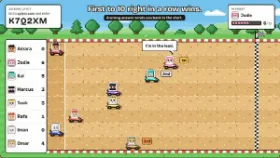
Several theme A sets are short, 10 to 12 questions, and in solo Racer the track is as long as the set, up to 12 cards. One wrong answer sends a student back to the start, so finishing takes a full run of right answers.